

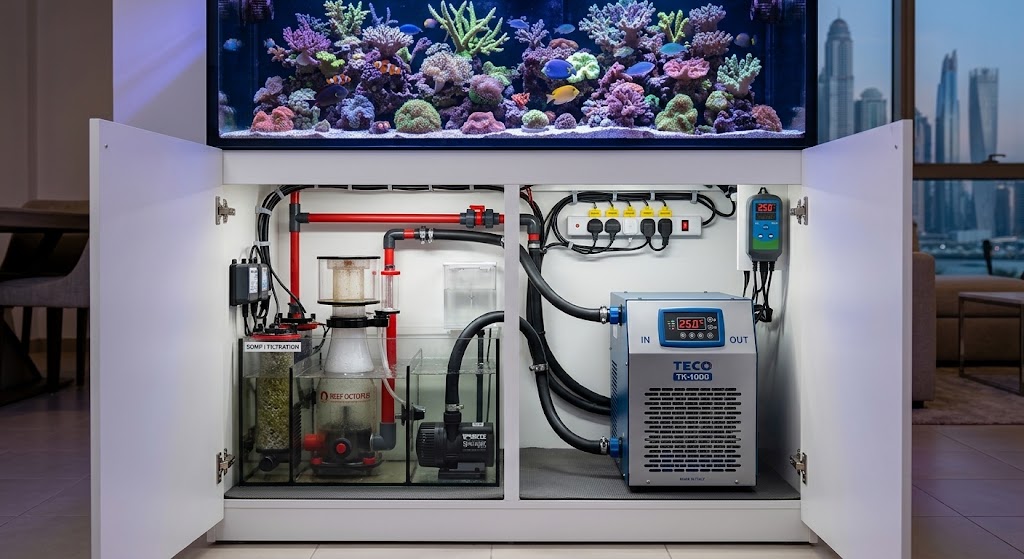
Dubai aquarium chiller sizing requires an engineered approach to protect delicate reef livestock against extreme Middle Eastern environmental conditions. Maintaining a thriving saltwater aquarium in the United Arab Emirates presents a thermal management challenge that standard European or American reefing guides completely ignore. While overseas Aquarist worry about heating their tanks during winter, Dubai reefers contend with ambient summer temperatures soaring past 45°C, high atmospheric humidity, and residential air conditioning dynamics that can turn a display tank into a biological disaster overnight.
Whether you are sizing a chiller for a nano reef in an apartment or managing a large multi-tank system or managing sensitive species like the Blue Splatter Toadstool Leather Coral , calculating your heat load requires accounting for ambient room spikes, electrical heat dissipation from submerged equipment, and thermal protection during extended travel.
1. The Dubai Thermal Challenge: Why Standard Sizing Fails
When performing Dubai aquarium chiller sizing, most manufacturer charts fail because they assume a baseline ambient room temperature between 21°C and 24°C with minimal fluctuation. In the Middle East, two main environmental factors break these standard assumptions:
Residential AC Cycling & Vacation Cut-Offs
When you are at home, central AC or district cooling (such as Empower/Emicool) keeps indoor temperatures around 22°C–24°C. However, when you go on vacation, travel for work, or step out for the weekend, turning off the AC or leaving it on a high Eco-mode (28°C–30°C) causes indoor ambient temperatures to spike rapidly. If building power trips or district cooling throttles during peak summer demand, ambient room air can easily reach 35°C+.
Latent Equipment Heat Load
Submerged return pumps, Wavemakers, protein skimmer motors, and high-intensity lighting systems like AquaIllumination LED lighting contribute significant mechanical and electrical heat directly into the water column.
Total Heat Load (BTU/hr)} = Ambient Pull-Down Load + Total Equipment Heat Input
2. Dubai Aquarium Chiller Sizing Matrix
To maintain a stable reef temperature of 24°C to 25°C, your Dubai aquarium chiller sizing calculations must account for a pull-down difference ($\Delta T$) of up to 10°C–12°C above normal room temperatures to survive AC shutdowns.
| Total System Volume (Liters) | Total System Volume (Gallons) | Recommended Chiller Horsepower (HP) | Minimum BTU Rating | Recommended Flow Rate (L/h) |
| 100L – 200L | ~25 – 50 gal | 1/10 HP | 1,000 – 1,500 BTU | 500 – 1,000 L/h |
| 200L – 400L | ~50 – 100 gal | 1/5 HP – 1/4 HP | 2,000 – 3,000 BTU | 1,000 – 1,800 L/h |
| 400L – 750L | ~100 – 200 gal | 1/3 HP – 1/2 HP | 4,000 – 6,000 BTU | 1,500 – 3,000 L/h |
| 750L – 1200L | ~200 – 300 gal | 3/4 HP – 1 HP | 7,500 – 11,000 BTU | 2,500 – 4,000 L/h |
| 1200L+ | 300+ gal | 1.5 HP+ (Commercial / Split Units) | 15,000+ BTU | 4,000+ L/h |
Pro Tip: Always size up by one tier in Dubai. A larger chiller runs for shorter periods (more efficient cooling cycles), experiences less mechanical wear on the compressor, and generates less ambient room heat than a smaller unit running continuously at 100% capacity.
3. Calculating Heat Transfer from Submerged DC/AC Pumps
A critical factor in accurate Dubai aquarium chiller sizing is calculating the heat output of your filtration equipment. Every watt of electricity consumed by a submerged pump is ultimately converted into thermal energy within your aquarium water.
Heat Conversion Formula
Watt of power consumption approx 3.412 BTU/hr of heat load
- AC Pumps: Traditional AC pumps run hotter and transfer up to 80%–90% of their rated power as direct water heat due to inductive resistance.
- Controllable DC Pumps: High-efficiency sine-wave DC pumps dissipate significantly less heat into the water, operating at roughly 50%–60% heat transfer efficiency compared to AC equivalents.
Equipment Heat Calculation Example
If your sump setup utilizes:
- Submerged Return Pump (DC): 50W
- Protein Skimmer Pump (DC): 30W
- Dual Wavemakers (In-tank motors): 30W total
- Total Equipment Power: 110 Watts
- Equipment Heat Input} = 110 W X 3.412 = 375.3 BTU/hr
This baseline heat input must be offset by your chiller before accounting for high ambient air temperatures.
4. Summer Travel Fail-Safes & Backup Power Options
Proper Dubai aquarium chiller sizing is only effective if your cooling system remains powered during emergency situations. When leaving your aquarium during peak summer months in the UAE, implement a multi-layered thermal safety protocol:
Dual Controller Redundancy
Never rely solely on the chiller’s internal thermostat. Wire your chiller through an independent external temperature controller (such as an Inkbird or Neptune Apex). Set the primary controller to cut power if temperature overshoots occur, preventing runaway cooling or relay failures.
AC Unit Backup & Smart Thermostats
Upgrade your home AC thermostat to a Wi-Fi-enabled smart system (e.g., Nest, Ecobee, or Tuya smart AC controllers). This allows you to monitor indoor ambient temperatures remotely from anywhere in the world and adjust cooling if room temperatures rise unexpectedly.
Dedicated Uninterruptible Power Supply (UPS)
A standard residential UPS cannot power a heavy inductive chiller compressor for long. Instead, route your setup through a split power scheme during outages:
- Critical UPS Line: Keeps return pumps, wavemakers, and smart temperature alerts online.
- Auto-Transfer Switch / Generator Backup: Ensures main power switches seamlessly back to building backup lines during summer grid glitches.
Evaporative Auto-Top-Off (ATO) Backup
If your chiller vents heat into an enclosed cabinet or room, evaporative cooling from auto-top-off fans increases significantly. Ensure your ATO reservoir holds enough RO/DI water to last at least 10–14 days of continuous summer operation.
