

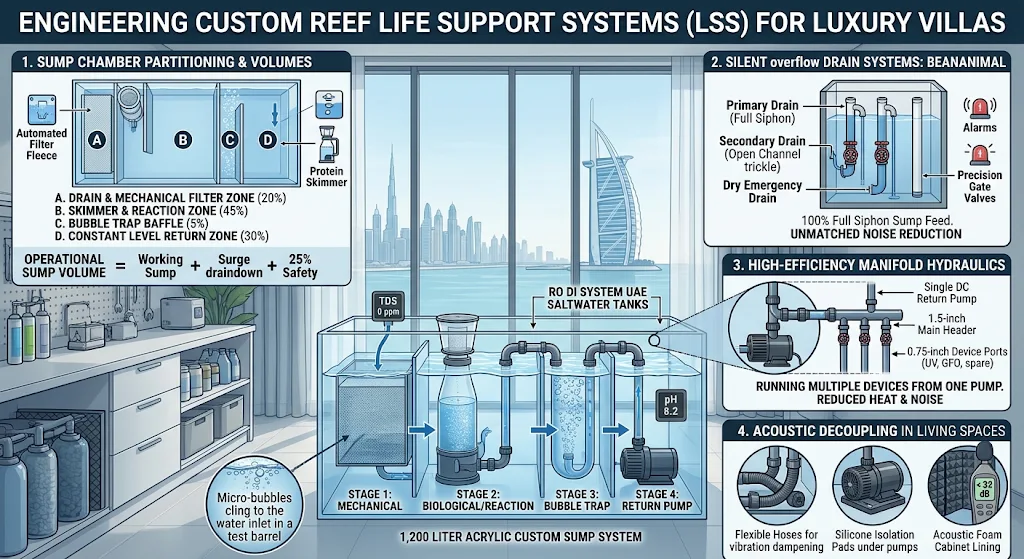
Designing a high-capacity display aquarium for a luxury residence or commercial environment requires precision biological and mechanical engineering. A premium living reef display cannot rely on off-the-shelf equipment. Instead, it demands a purpose-built custom reef life support system designed to sustain delicate SPS corals and heavy fish loads while operating dead-silently inside residential living spaces.
In luxury installations across the UAE, life support system (LSS) design must account for spatial constraints, heat dissipation, high flow velocities, and absolute flood protection. Rushing into hydraulic design without calculating head loss or sizing sump chambers correctly leads to noisy plumbing, micro-bubble proliferation, and unstable water chemistry.
This guide breaks down the core mechanical engineering principles required to size sumps, configure whisper-quiet siphon drains, and plumb high-efficiency manifolds for a custom reef life support system. To maintain optimal environmental parameters across your entire installation, pair your system design with our Dubai Aquarium Chiller Sizing Guide, our RO DI System UAE Saltwater Tanks Guide, and our Marine Aquarium Maintenance Pricing in Dubai Guide.
1. Sump Chamber Partition Ratios & Surge Volume Calculations
The sump serves as the biological heart and operational foundation of any custom reef life support system. A poorly configured sump causes water level fluctuations, starves return pumps, and spews micro-bubbles into the main display.
Mathematical Sump Sizing Standard
An operational sump must handle two distinct volumes: working volume (normal operating level) and surge capacity (water draining down from display piping and overflow boxes during a power outage).
Minimum Sump Capacity= Working Sump Volume + Display Draindown Surge Volume+ 25% Safety Buffer
For a standard 1,000-liter luxury display tank draining 3 cm of surface water during a shutdown
Surge Volume = (Length (cm) x Width (cm) x 3 cm) / 1000 ≈ 60 to 90 Liters
Sump Compartment Partitioning Guidelines
- Chamber 1: Mechanical Intake (20% Area): Receives primary siphon drains. Houses automated filter fleece rollers or dual-layer media socks to trap solid waste before it breaks down into ammonia.
- Chamber 2: Reaction & Skimmer Zone (45% Area): Maintains a fixed water height (typically 20–24 cm) enforced by a baffle. Houses protein skimmers, media reactors, and biological substrates.
- Bubble Trap Baffle System (5% Area): A 3-baffle "over-under-over" pass with 2.5 cm gaps retards water velocity, allowing entrained air bubbles to burst before entering the pump chamber.
- Chamber 3: Return Reservoir (30% Area): Houses the primary return pumps and Auto Top-Off (ATO) float sensors. Must be sized generously to absorb daily evaporation without triggering low-water safety shutoffs.
2. Overflow Siphon Architectures: BeanAnimal vs. Herbie Drain Systems
In high-end villa installations, noise management is paramount. Open-channel drains like Durso standpipes gurgle continuously and introduce massive amounts of air into the sump. A luxury custom reef life support system relies on full-siphon plumbing architectures.
Herbie Siphon System (2 Standpipes)
- Primary Drain: Operates as a 100% full siphon, tuned via a precision PVC gate valve (never a ball valve). Runs dead-silent with zero air entrainment.
- Secondary Emergency Drain: Sits slightly above the primary siphon line. Carries a small trickle of water to handle flow fluctuations and acts as a safety drain if the primary siphon clogs.
BeanAnimal Siphon System (3 Standpipes — Luxury Gold Standard)
- Primary Full Siphon: Throttled down by a gate valve to carry ~80–90% of total drain capacity under full liquid pressure.
- Open Channel Standpipe: Equipped with an air tube at the top to break siphons under normal conditions. It carries the remaining 10–20% of flow, stabilizing water height in the overflow box.
- Dry Emergency Drain: Positioned above the operating water level. Remains completely dry during normal operation and only activates if both primary and secondary drains become obstructed.
For large-scale custom builds exceeding 800 liters, the BeanAnimal configuration is mandatory to guarantee zero flood risk and complete acoustic isolation.
3. High-Efficiency Manifold Hydraulics & Head Loss Management
Rather than placing multiple noisy, heat-producing feed pumps inside the sump to power UV sterilizers, media reactors, and chillers, a professional custom reef life support system utilizes a unified manifold system fed by a single high-flow DC return pump.
Manifold Engineering Principles
- Oversized Main Feed Pipe: Size the main return line one pipe diameter larger than the return pump outlet (e.g., 1.5-inch pipe on a 1-inch pump outlet) to reduce friction loss and maximize volume.
- Pressure-Equalized Loop: Run a main trunk line above or beside the sump, installing 0.75-inch true-union ball valves for each auxiliary device.
- Dedicated Auxiliary Ports:
- Port A: Feed to High-Output UV Sterilizer (calibrated for targeted pathogen/parasite dwell time).
- Port B: Feed to Fluidized Media Reactors (Carbon / GFO / Bio-Pellets).
- Port C: Feed to Secondary Display Return or Auxiliary Chiller Loop.
- Port D: Spare Service Port for maintenance bypass or system flushing.
Total Dynamic Head (TDH) & Head Loss Calculation
When selecting a primary DC pump for a custom reef life support system, you must calculate Total Dynamic Head (TDH) to ensure targeted turnover rates (typically 5x to 8x system volume per hour through the sump):
TDH = Static Head (Vertical Distance) + Friction Loss (Pipe length, elbows, gate valves, manifolds)
As a rule of thumb, every standard 90-degree PVC elbow adds equivalent friction loss equal to approximately 0.6 meters (2 feet) of straight pipe. Utilize sweep 45-degree elbows or flexible braided PVC where possible to preserve pump output and conserve energy.
4. Acoustic Decoupling & Vibration Dampening in Living Spaces
In high-end villa construction, low-frequency hums and pump vibrations can amplify through wooden cabinetry, tiled floors, and home drywall. A noise-free custom reef life support system incorporates strict mechanical isolation protocols.
Decoupling Techniques
- Silicone Isolation Pads: Position high-density, marine-grade silicone pads beneath all submerged return pumps, skimmer bases, and external booster pumps.
- Flexible Hose Transitions: Never connect rigid Schedule 40 PVC piping directly to a pump outlet. Install a minimum 30 cm section of reinforced silicone or flexible PVC tubing between the pump fitting and rigid pipework to absorb motor resonance.
- Acoustic Cabinet Lining: Line internal sump cabinet doors with closed-cell acoustic foam panels to absorb air-shredding noise from skimmer venturis and water splashing.
- Pipe Mounting Isolation: Secure all vertical and horizontal drain runs to cabinet framing using rubber-lined split-ring pipe hangers rather than rigid plastic straps.
For systems that have experienced long operational cycles or require hardware overhauls, check our Equipment Audit Guide to identify worn pump bearings before noise levels degrade indoor comfort.
Summary Engineering Matrix for Custom Life Support Systems
| Metric / Subsystem | Design Target | Failure Prevention Action |
| Sump Turnover | 5x to 8x Total Volume / Hour | Calculate TDH and size DC return pump at 60% capacity for headroom. |
| Drain Configuration | 3-Pipe BeanAnimal Overflow | Install precision PVC gate valve on primary siphon line only. |
| Baffle Water Velocity | < 0.05 m/s across bubble trap | Space baffles at least 2.5–3.0 cm apart to force bubbles upward. |
| Manifold Pressure | Equalized flow across all ports | Size main header trunk to 1.5 inches before stepping down to 0.75-inch ports. |
| Acoustic Threshold | < 32 dB at 1-meter distance | Use flexible silicone transitions and vibration-dampening pads on all pumps. |
By applying rigorous hydraulic calculations, silent siphon drain configurations, and noise-decoupling protocols, an engineered custom reef life support system delivers crystal-clear water parameters, complete flood safety, and uncompromised luxury living.
