

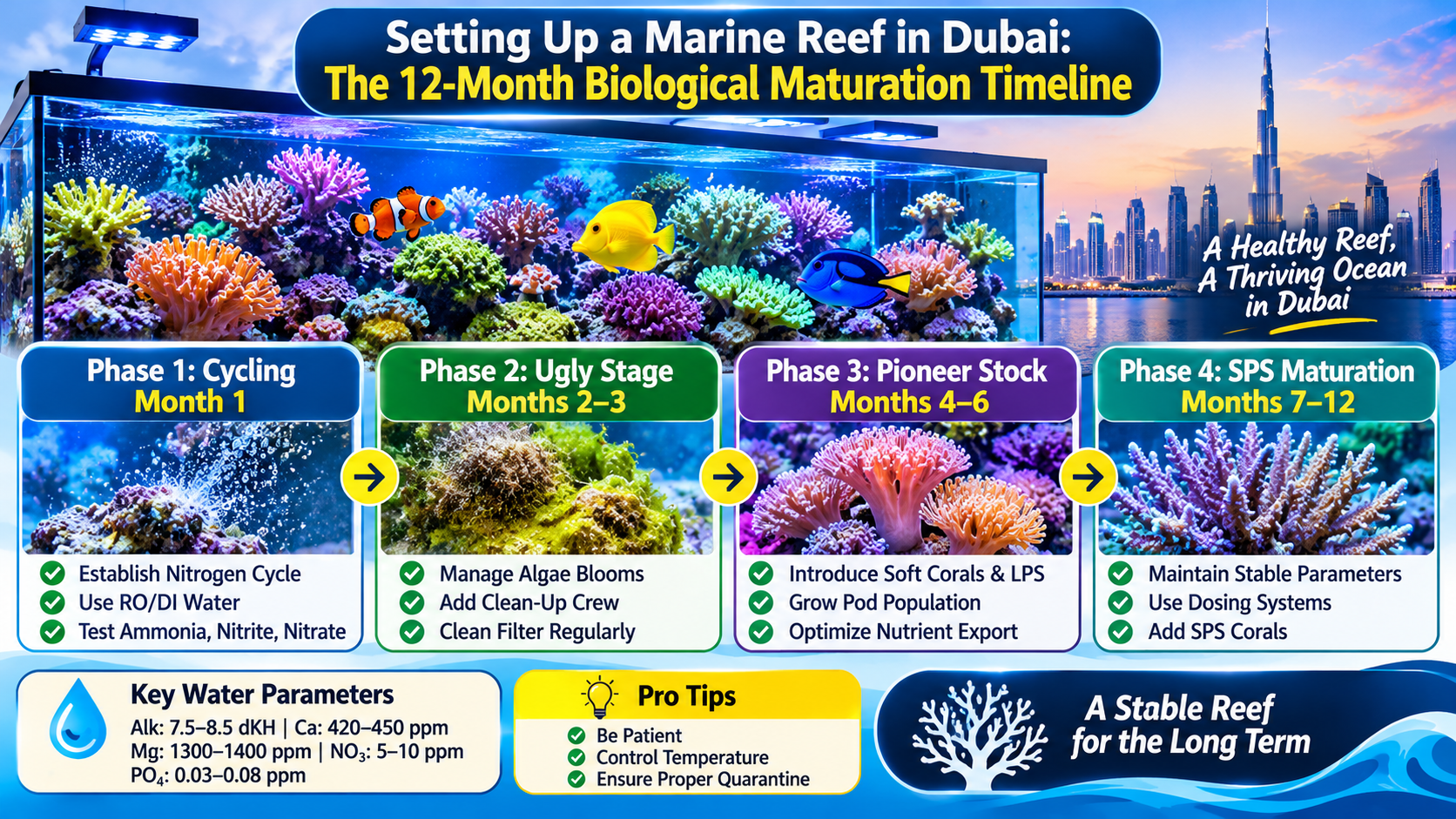
Establishing a thriving marine reef aquarium in the UAE requires patience, rigorous water parameter control, and a deep understanding of microbial ecology. Rushing livestock into a freshly filled glass box is the primary cause of catastrophic tank crashes. When successfully setting up a marine reef in Dubai, your aquatic environment must transition through predictable biochemical phases, moving from initial sterile synthetic salt mixes to a stable, biologically diverse ecosystem capable of supporting delicate Small Polyped Stony (SPS) corals.
Because high ambient temperatures and seasonal air conditioning cycles in the Emirates place unique demands on evaporation rates and chiller performance, tracking a structured calendar is essential. This 12-month milestone guide outlines every critical phase required when setting up a marine reef in Dubai, ensuring your custom display achieves long-term biological stability.
To keep your water chemistry pristine during every phase of maturation, integrate your setup schedule with our Custom Reef Life Support System Design Guide, our RO DI System UAE Saltwater Tanks Guide, and our Marine Aquarium Maintenance Pricing in Dubai Guide.
1. Month 1: The Nitrogen Cycle and Micro-Fauna Seeding
The foundation of any healthy marine reef in Dubai begins with establishing the nitrogen cycle. Without a robust colony of nitrifying bacteria (Nitrosomonas and Nitrobacter), toxic ammonia excreted by fish or derived from decaying organic matter will accumulate rapidly.
Key Milestones & Actions
- Initial Fill and Salinity Lock: Fill the display and sump using zero-TDS water produced via a multi-stage RO/DI unit, mixed with pharmaceutical-grade marine salt to achieve a stable 1.025–1.026 specific gravity at 25°C.
- Ammonia Source & Seeding: Introduce dry or cured live rock, high-quality live aragonite sand, and bottled bacterial spores. Add a pure ammonium chloride source or a raw seafood pellet to trigger the primary cycle when setting up a marine reef in Dubai.
- Testing Parameters: Test daily for Total Ammonia Nitrogen (TAN), Nitrite (NO2-), and Nitrate (NO3-). The cycle is officially complete when 2 ppm of ammonia converts entirely to nitrate within a 24-hour window.
2. Months 2–3: The "Ugly Stage" and Clean-Up Crew Introduction
Once the nitrogen cycle settles, every new marine reef in Dubai enters the dreaded "ugly stage." This phase is characterized by successive blooms of brown diatoms, green hair algae, and maroon cyanobacteria as excess silicates leach from new glass, rocks, and sand beds.
Key Milestones & Actions
- Do Not Panic or Over-Medicate: Algae and diatom blooms are a natural, necessary part of biological maturation when setting up a marine reef in Dubai. Avoid harsh chemical algaecides that disrupt the developing microbiome.
- Deploy a Diverse Clean-Up Crew (CUC): Introduce herbivorous grazers—such as Trochus snails, Turbo snails, Cerith snails, and blue-legged hermit crabs—to consume micro-algae films.
- Mechanical Filtration Adjustment: Frequently clean automated filter fleece rollers or swap filter socks to physically remove suspended detritus trapped by the rising biological load.
3. Months 4–6: Soft Corals, Hardy LPS, and Nutrient Export
By month four, the microbial web matures significantly. Microscopic fauna like copepods, amphipods, and calcareous sponges populate the live rock work, establishing a stable micro-ecosystem across your marine reef in Dubai.
Key Milestones & Actions
- Introduction of Pioneer Livestock: Add hardy livestock, including captive-bred clownfish, damselfish, or robust soft corals (Sarcophyton leather corals, Zoanthids, and Discosoma mushrooms).
- Stabilizing LPS Corals: Introduce resilient Large Polyped Stony (LPS) corals such as Euphyllia (Hammer and Torch corals), Favia, and Acanthastrea, monitoring daily alkalinity consumption closely.
- Refining Nutrient Export: Calibrate your protein skimmer, adjust lighting intensity and photoperiod ramps, and consider running GFO (Granular Ferric Oxide) or carbon reactors to control rising phosphate and nitrate levels while setting up a marine reef in Dubai.
4. Months 7–12: SPS Coral Maturation and Parameter Stability
The final phase transforms a standard saltwater tank into an elite, high-end reef display. True Small Polyped Stony (SPS) corals—such as Acropora, Montipora, and Stylophora—demand pristine, ultra-stable water parameters that only a fully matured marine reef in Dubai can sustain.
Key Milestones & Actions
- Strict Parameter Benchmarks: Maintain absolute stability across core chemical metrics:
- Alkalinity: 7.5 to 8.5 dKH (fluctuation under 0.3 dKH per 24 hours).
- Calcium: 420 to 450 ppm.
- Magnesium: 1300 to 1400 ppm.
- Nitrate (NO3): 5 to 10 ppm.
- Phosphate (PO4): 0.03 to 0.08 ppm.
- Automated Dosing Integration: Install multi-head peristaltic dosing pumps or a calcium reactor (CaRx) to replenish consumed calcium, alkalinity, and trace elements automatically.
- Long-Term Livestock Expansion: Slowly introduce sensitive tangs, wrasses, and demanding SPS colonies, ensuring every addition is quarantined per our Quarantine Marine Fish Dubai Protocol.
Summary 12-Month Maturation Matrix
| Maturation Phase | Target Timeline | Primary Biological Focus | Key Water & Equipment Actions |
| Phase 1: Cycling | Months 1 | Establishing Nitrosomonas and Nitrobacter colonies | Zero-TDS RO/DI water, pure ammonia testing, bacterial seeding. |
| Phase 2: Ugly Stage | Months 2–3 | Diatom, dinoflagellate, and hair algae blooms | Introduce clean-up crew (CUC); clean filter rollers frequently. |
| Phase 3: Pioneer Stock | Months 4–6 | Soft corals, hardy LPS, and pod population growth | Add resilient livestock; calibrate protein skimmers and lighting. |
| Phase 4: SPS Maturation | Months 7–12 | Full biological equilibrium for Acropora and SPS corals | Strict parameter tracking; install automated dosing pumps and CaRx. |
By respecting this 12-month biological timeline when setting up a marine reef in Dubai, you ensure your luxury ecosystem develops the robust metabolic stability required to thrive for years to come.
