

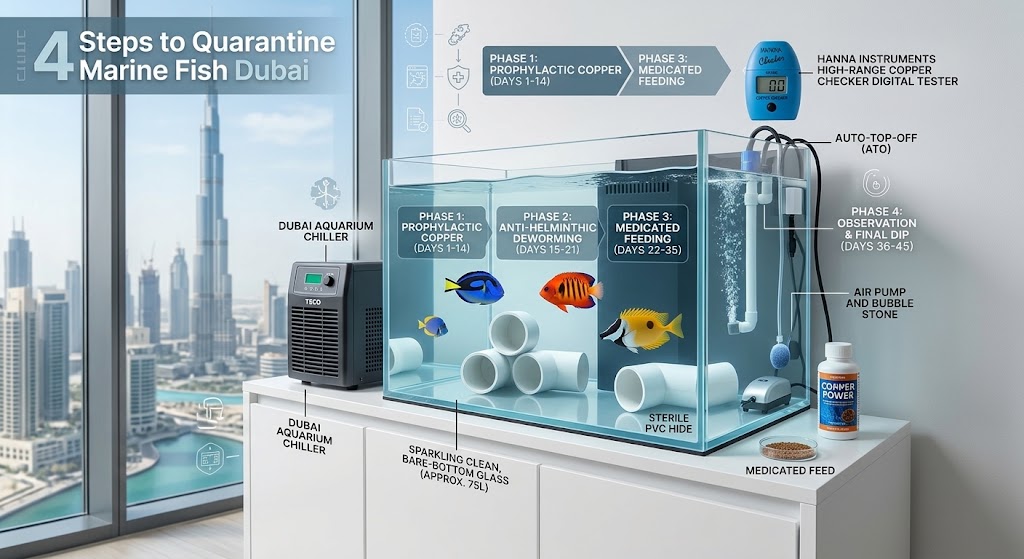
Knowing how to quarantine marine fish Dubai requires a structured, multi-stage biosecurity protocol designed for extreme transit conditions. The United Arab Emirates operates as a major central transshipment node for international wild marine livestock. Saltwater species entering local retail facilities across Dubai—originating from harvest points across the Red Sea, Sri Lanka, Indonesia, and the Philippines—undergo intensive transport schedules, temperature swings, and severe osmotic stress.
By the time wild-caught marine livestock reaches a local tank, their natural slime coats are depleted and their immune systems are compromised. This makes them active hosts for lethal parasites including Cryptocaryon irritans (Marine Ich), Amyloodinium ocellatum (Marine Velvet), monogenean flukes, and internal flagellates. Placing unquarantined wild fish directly into a high-value home display tank can trigger systemic parasite outbreaks that wipe out delicate teleost fish within 48 to 72 hours.
Follow this 4-phase biological quarantine protocol to eliminate pathogens systematically before introducing any wild specimen into your display.
1. The Transshipment Challenge: Why You Must Quarantine Marine Fish Dubai
Unlike freshwater farm-raised species or domestic captive-bred marine fish, wild-caught marine livestock imported into the UAE endures complex multi-hub logistics that alter their baseline biology. When you execute a protocol to quarantine marine fish Dubai, you are overcoming three primary transit stressors:
- Ammonia Toxicity Spikes: During transit inside sealed shipping bags, fish excrete ammonium ions (NH4+). When the bag is opened in Dubai, accumulated CO2 escapes, causing the pH to rise rapidly. This shift instantly converts non-toxic ammonium into lethal, free toxic ammonia (NH3).
- Stress-Induced Pathogen Proliferation: Transport stress elevates cortisol levels, suppressing the mucous coat of marine teleosts. Latent Amyloodinium (Velvet) or Brooklynella hostilis trophonts multiply rapidly on stressed gill tissue.
- Wholesaler Cross-Contamination: Global collection hubs frequently hold wild specimens from different geographic regions within shared recirculation vats, producing drug-resistant parasitic strains.
2. Phase 1: Prophylactic Copper Protocols to Quarantine Marine Fish Dubai (Days 1–14)
Target Pathogens: Cryptocaryon irritans (Marine Ich) and Amyloodinium ocellatum (Marine Velvet)
Phase 1 establishes a precise chemical threshold to destroy free-swimming protozoan theronts while maintaining safety for the host fish. Maintaining stable ionic and chemical parameters during this phase—similar to proper heat management detailed in our Dubai Aquarium Chiller Sizing Guide—is critical for survival.
Operational Parameters & Dosing
- Medication Selection: Use a high-purity Chelated Copper solution (such as Copper Power or Coppersafe). Avoid raw ionic copper compounds, as they are too harsh for sensitive wild species like fairy wrasses, dwarf angels, and tangs.
- Target Concentration: Maintain 2.25 ppm to 2.50 ppm chelated copper.
- 4-Day Ramp-Up Schedule:
- Day 1: Fill the quarantine tank (QT) with clean 35 ppt (1.025 SG) saltwater. Introduce fish and hold at 0.0 ppm copper for 24 hours to stabilize from transit shock.
- Day 2: Dose chelated copper to reach 1.0 ppm.
- Day 3: Increase concentration to 1.75 ppm.
- Day 4: Bring copper to the full therapeutic level of 2.25 ppm to 2.50 ppm.
Critical Rule: Measure copper levels twice daily using a digital colorimeter like theHanna Instruments High-Range Copper Checker. If copper concentration drops below 2.0 ppm at any point, free-swimming theronts can survive, and the 14-day therapeutic timer must reset back to Day 1.
3. Phase 2: Anti-Helminthic Deworming (Days 15–21)
Target Pathogens: Monogenean Gill and Skin Flukes (Neobenedenia & Anacanthorus), Tapeworms, and Turbellarians
After eradicating protozoan parasites, the protocol transitions to targeting macro-parasites and skin flukes that remain unbothered by copper ions.
Dosing Schedule & Aeration Protocol
- Therapeutic Dosage: Administer 2.5 mg/L (2.5 ppm) of Praziquantel (e.g., PraziPro).
- Dose 1 (Day 15): Perform a 25% water change to clear organic debris. Premix Praziquantel in a container of warm RO/DI water, then pour it into a high-flow zone of the QT.
- Dose 2 (Day 20–22): Repeat the 2.5 mg/L dosage 5 to 7 days later.
Why a second dose? Praziquantel destroys adult flukes instantly but does not destroy unhatched fluke eggs. The second treatment destroys newly hatched juveniles before they reach sexual maturity and lay new eggs.
Secondary Dose Timing (Days)=f(Water Temperature)
At typical Dubai quarantine room temperatures (25°C–26°C), fluke eggs hatch rapidly, making the 5-to-7-day secondary window essential for total eradication.
Oxygen Warning: Praziquantel acts as a carbon source that stimulates rapid bacterial growth, which drops dissolved oxygen (DO) levels. Run a dedicated air stone continuously throughout Phase 2 to prevent hypoxia.
4. Phase 3: Medicated Feeding & Hyposalinity Options (Days 22–35)
Target Pathogens: Internal Flagellates (Hexamita), Bacterial Enteritis, and Internal Worms
External treatments cannot treat deep intestinal parasites. Phase 3 uses a medicated feeding regimen to clean out internal digestive pathogens, preserving high-value marine livestock such as those featured in our Blue Splatter Toadstool Coral Care Guide.
Medicated Feed Preparation
Water-bound medications are ineffective against internal gut parasites. Prepare a bound medicated food paste using:
- 1 Scoop: Metronidazole (Anti-protozoan) or Kanamycin Sulfate (Broad-spectrum antibiotic)
- 1 Scoop: Seachem Focus (Polymer binding agent to prevent water leaching)
- 1 Cube: Thawed frozen Mysis or Artemia
Mix the binder and medication thoroughly into the food and feed twice daily for 10 to 14 consecutive days.
Alternative Hyposalinity Protocol (For Copper-Sensitive Species)
When attempting to quarantine marine fish Dubai for copper-sensitive wild species (e.g., Acanthurus Achilles tangs, leopard wrasses, or pipefish), substitute Phase 1 with a Hyposalinity Protocol:
- Lower specific gravity (SG) to 1.009 over 48 hours using fresh RO/DI water top-offs.
- Maintain an exact specific gravity of 1.009 SG (15 ppt) for 30 consecutive days.
- Mechanism: At 1.009 SG, external osmotic pressure ruptures free-swimming Cryptocaryon tomonts while teleost fish maintain internal osmotic balance through osmoregulation.
5. Phase 4: Active Carbon Clearing & Final Observation (Days 36–45)
Target: Absorbing residual medications, verifying immune strength, and acclimating fish to normal water parameters.
Never move a fish straight from medicated water into a final display system.
Step 1: Active Carbon & Synthetic Resin Filtration
Add active virgin lignite carbon and synthetic adsorbents (such as Seachem Purigen) into the filter path to remove all remaining copper, praziquantel, and antibiotic traces over 48 hours.
Step 2: 14-Day Unmedicated Observation Window
Observe the specimen in clean, unmedicated saltwater for 14 days. Confirm the fish meets four health benchmarks before transfer:
- Normal Respiration Rate: Opercular gill movement stays under 80 beats per minute without flaring.
- Clear Epidermis: Absence of excessive mucous patches, micro-vesicles, or damaged fin rays.
- Weight Recovery: Full, rounded dorsal muscle mass behind the head (no pinched lateral lines).
- Active Feeding: Eagerly taking dry pelleted feeds and frozen foods.
Step 3: Diagnostic Fresh Water Dip Prior to Transfer
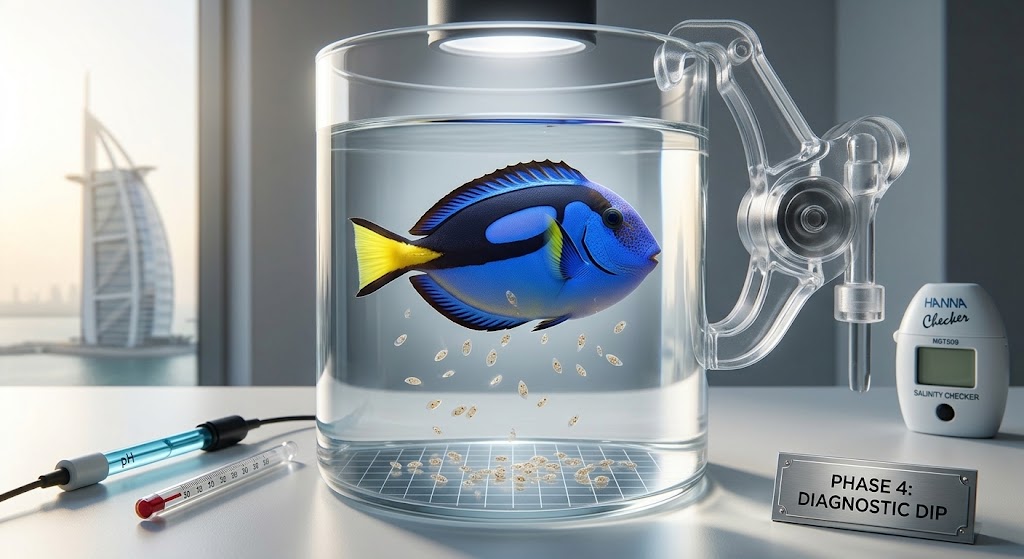
Before moving the fish to your display tank, conduct a 5-minute fresh water dip using temperature- and pH-matched RO/DI water in a clear glass vessel. If opaque, sesame-seed-like specks dislodge from the skin and drop to the bottom, flukes are still present—return the fish to Phase 2 immediately. For broader community discussions on identifying dislodged flukes, consult the expert disease diagnosis threads on Reef2Reef Marine Aquarium Forum.
If the skin remains clear, move the fish into the display using a clean vinyl specimen container (do not transfer quarantine water into your main display tank).
Summary Protocol to Quarantine Marine Fish Dubai
| Phase | Duration | Target Pathogens | Chemical / Method | Target Threshold | Operational Note |
|---|---|---|---|---|---|
| Phase 1 | Days 1–14 | Marine Ich & Marine Velvet | Chelated Copper | 2.25 – 2.50 ppm | Test twice daily with a digital checker. Never drop below 2.0 ppm. |
| Phase 2 | Days 15–21 | Gill Flukes & Tapeworms | Praziquantel | 2.5 mg/L (2 Doses) | Repeat dose on Day 5–7. Run extra aeration. |
| Phase 3 | Days 22–35 | Internal Parasites & Bacteria | Metronidazole + Binder in Food | 10–14 Days Oral Meds | Bind meds into frozen food using a polymer agent. |
| Phase 4 | Days 36–45 | System Recovery & Monitoring | Carbon + FW Dip | 0.0 ppm Meds / 1.025 SG | Conduct a 5-min diagnostic dip before final entry. |
Enforcing this biosecurity framework allows aquarists to successfully quarantine marine fish Dubai, protecting reef display investments and guaranteeing long-term livestock health.
