

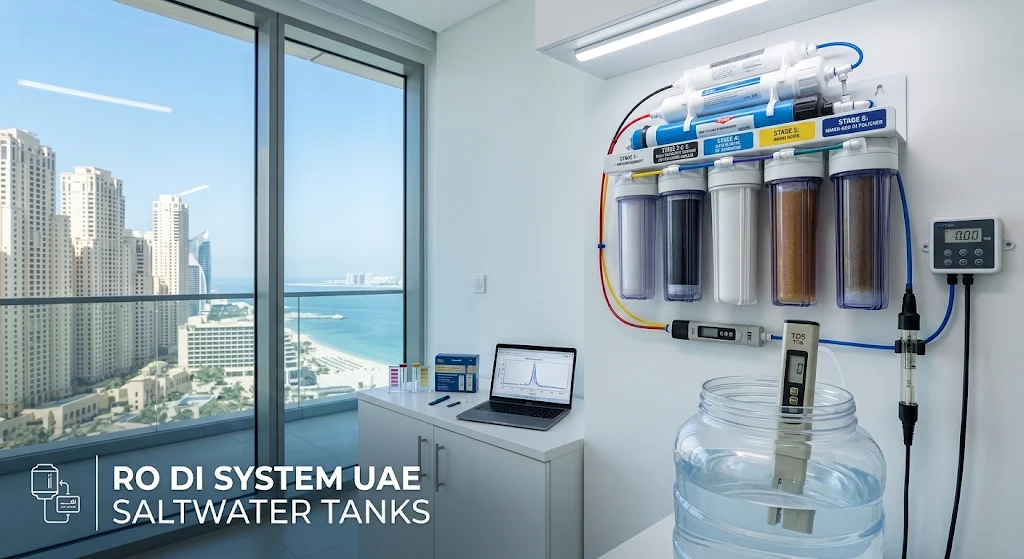
Deploying a high-efficiency RO DI system UAE saltwater tanks require is non-negotiable for any aquarist maintaining a reef display in the Middle East. A common question among regional hobbyists is: "Is Dubai tap water safe for marine aquariums?" The short answer is an absolute no.
While municipal tap water in Dubai, Abu Dhabi, and Sharjah is safe for human consumption, its chemical composition—resulting from thermal desalination and municipal distribution—is toxic to delicate saltwater species. Raw tap water contains high Total Dissolved Solids (TDS), chloramines, and silicates that fuel nuisance dinoflagellates and stress corals.
To protect marine life and complement protocols like our Dubai Aquarium Chiller Sizing Guide and Quarantine Marine Fish Dubai Protocol, aquarists must configure an RO DI system UAE saltwater tanks can rely on for 0.00 TDS water.
1. UAE Municipal Water Chemistry: Why an RO DI System UAE Saltwater Tanks Need is Essential
Municipal tap water across the UAE relies primarily on seawater desalination from the Arabian Gulf. While this yields clean drinking water, key distribution factors necessitate a specialized RO DI system UAE saltwater tanks depend on:
Baseline UAE Water Parameters
- Raw Feed Water TDS: 120 ppm – 350+ ppm across local residential towers and villa communities.
- Chloramines & Free Chlorine: Municipal authorities add heavy disinfectants across distribution networks, exhausting standard carbon blocks prematurely.
- Silicate (SiO2SiO_2SiO2) Breakthrough: Desalination leaves residual silicates between 2.0 mg/L and 5.0 mg/L, causing diatom blooms if left unmanaged.
- Elevated Water Temperature: Summer tap temperatures frequently exceed 35°C–40°C, altering RO membrane pore density and increasing salt passage.
Understanding these factors shows why relying on a standard 3-stage filter without a proper RO DI system UAE saltwater tanks use leads to coral loss.
2. Configuring an RO DI System UAE Saltwater Tanks Depend On
Standard 3-stage RO filters built for overseas tap water fail rapidly under Gulf conditions. To produce true 0.00 TDS output, your RO DI system UAE saltwater tanks rely on should feature a 5-stage or 6-stage filtration path:
Stage 1: 1-Micron Polypropylene Sediment Filter
Rooftop storage tanks act as settling reservoirs for fine dust and sand. A 1-micron filter captures sediment before it fouls carbon blocks.
Stages 2 & 3: Dual Catalytic Carbon Blocks (Chloramine Shield)
Standard carbon blocks cannot split chloramine bonds fast enough at operational flow rates. Utilizing dual catalytic carbon blocks breaks chloramine bonds, preventing chlorine from degrading your membrane.
Stage 4: High-Rejection TFC Reverse Osmosis Membrane
Select a High-Rejection (98%+) TFC membrane like those engineered by Dow Filmtec Water Solutions. A 98% rejection membrane treating 200 ppm feed water reduces product water to ~4 ppm TDS, preserving DI resin downstream.
Stages 5 & 6: Dual Deionization (DI) Resin Chambers
To stop silicate breakthrough when running an RO DI system UAE saltwater tanks utilize, run a dual-bed DI configuration:
- Stage 5 (Prophylactic Anion/Cation Bed): Captures charged ions and silicate compounds.
- Stage 6 (Mixed-Bed Polishing Chamber): Polishes water to true 0.00 TDS (0.0μS/cm conductivity).
Pro Tip: Monitor water parameters using inline meters fromHM Digital Testing Instrumentation. When the mid-stage meter reads 1 ppm TDS, move Stage 6 to Stage 5 and pack fresh resin into Stage 6.
3. Exhaustion Rates for an RO DI System UAE Saltwater Tanks Require
High summer feed temperatures combined with municipal chloramines accelerate filter exhaustion. Maintain this operational maintenance schedule for your RO DI system UAE saltwater tanks:
| Filter Stage | Media Type | Average UAE Lifespan | Failure Indicator |
|---|---|---|---|
| Stage 1 | 1-Micron Sediment | 2 to 3 Months | Visible brown discoloration; pressure drop across gauge. |
| Stage 2 & 3 | Catalytic Carbon Block | 4 to 6 Months (or 1,500 Gal) | Total Chlorine test kit reveals >0.1 ppm post-carbon. |
| Stage 4 | 75/100 GPD TFC Membrane | 18 to 24 Months | Membrane Rejection Rate drops below 96%. |
| Stage 5 & 6 | Color-Changing DI Resin | 150 to 300 Liters (Feed Dependent) | Inline TDS meter reads 1 ppm post-DI; color shift to golden yellow. |
Following this replacement schedule ensures your RO DI system UAE saltwater tanks setup continues producing 0 TDS water without interruption.
4. Cost Analysis: Home Production vs. Store-Bought Water
Operating an RO DI system UAE saltwater tanks require offers clear financial advantages over buying store water.
Cost Calculation Formula
Cost Per Gallon=Total Production Volume (Gallons)Municipal Water Fee+Consumable Replacement Costs
Financial Comparison (100-Gallon System / 500L Annual Top-off & Water Changes)
- Purchasing LFS RO/Saltwater:
- Average Cost: AED 1.50 to AED 2.50 per Gallon
- Annual Transport & Fuel Cost: AED 600+
- Total Annual Cost: ~AED 1,850 (Plus labor and unverified TDS risk)
- Home 6-Stage RO DI System UAE Saltwater Tanks Setup:
- System Initial Capital Expense: AED 850 (One-time)
- Annual Consumables (Sediment, Carbon, DI Resin): AED 350
- DEWA Municipal Water Input (~AED 0.01 per Gallon): AED 15
- Total Year 1 Cost: AED 1,215
- Total Year 2+ Operating Cost: ~AED 365 / Year
Installing your own RO DI system UAE saltwater tanks demand pays for itself within 7 to 9 months. It protects livestock—from specimens highlighted in our Blue Splatter Toadstool Coral Care Guide to wild marine imports—against chloramines and silica impurities.
Summary Protocol for RO DI System UAE Saltwater Tanks
| Parameter | Target Threshold | Operational Action |
|---|---|---|
| Raw Water Input | 120–350+ ppm TDS | Install booster pump if feed pressure is under 50 PSI. |
| Post-RO Membrane | < 5 ppm TDS | Replace membrane if rejection rate drops below 96%. |
| Post-DI Output | 0.00 ppm TDS | Never use water in display if output reads 1+ ppm TDS. |
| Chloramine Removal | 0.0 ppm Free/Total Chlorine | Use dual catalytic carbon blocks rated for chloramines. |
By installing and maintaining a purpose-built RO DI system UAE saltwater tanks require, aquarists eliminate water quality variables and build a pure foundation for healthy marine ecosystems.
